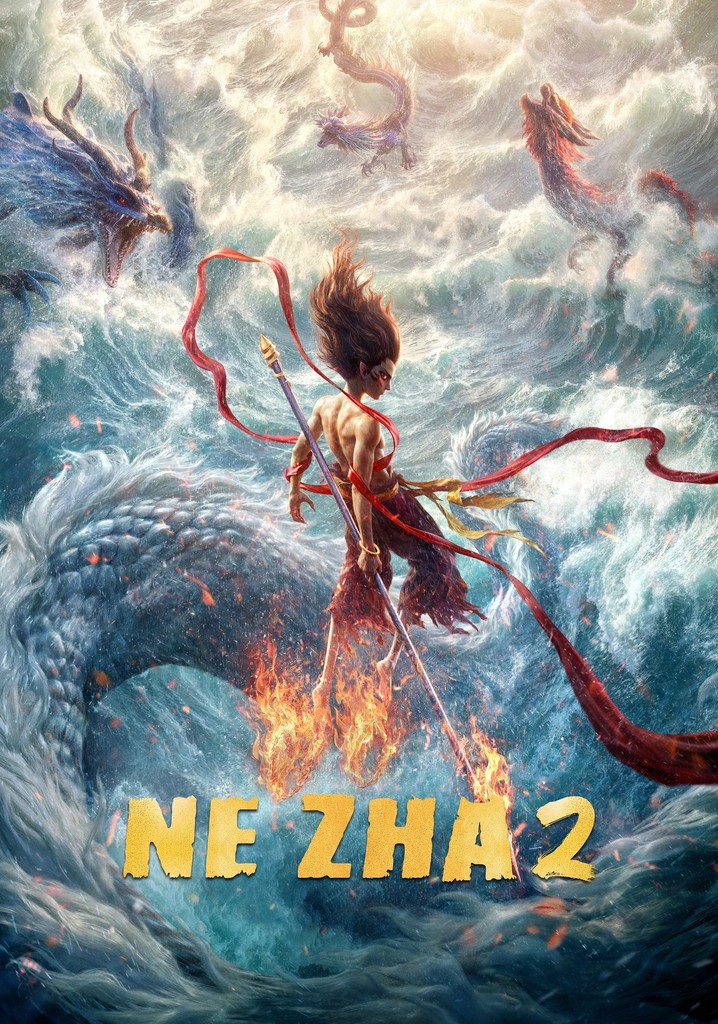
Ne Zha 2
Ne Zha 2: When Myths Bleed into Reality and Shatter Box Office History
In the annals of animation history, 2025 will not be remembered for the return of a Pixar emotion or a plumber jumping on mushrooms. It will be remembered as the year a rebellious demon child from Chinese folklore rose from the ashes to conquer the world. Ne Zha 2 (哪吒之魔童闹海), the sequel to the 2019 phenomenon, has not merely performed well; it has rewritten the rulebook of global cinema, grossing over $2 billion worldwide and dethroning titans to become the highest-grossing animated film of all time.
But to look at Ne Zha 2 solely through the lens of its financial windfall is to miss the point entirely. This film is a roaring, visual symphony of defiance—a “punk rock” take on classical mythology that resonates as deeply with a global audience as it does with its domestic base. With A24 spearheading its North American distribution and an HBO Max streaming release slated for late December 2025, the world is finally witnessing the full force of the “Donghua” (Chinese animation) renaissance.
The Latest News: A Global Conquest
As of late 2025, the headlines are dominated by Ne Zha 2’s unprecedented trajectory. Following its explosive debut during the Chinese New Year, the film has sustained momentum that few blockbusters ever achieve. The latest updates confirm that the film has successfully crossed the $2.2 billion mark, surpassing previous heavyweights like Inside Out 2 and The Lion King (2019).
Critically, the film’s expansion into the West has been met with rapturous acclaim. Distributed by the tastemaker studio A24—a rare move for an animated blockbuster—the English dub features the legendary Michelle Yeoh, bringing a new layer of gravitas to the production. The news that the film will hit HBO Max on December 24, 2025, positions it as the ultimate holiday watch, ensuring that its cultural footprint will extend well into 2026.
Plot: The Architecture of Resurrection
The narrative of Ne Zha 2 picks up immediately after the cataclysmic events of the first film. For the uninitiated, the original film ended with Ne Zha (the reincarnation of the Demon Orb) and Ao Bing (the Spirit Pearl) sacrificing their physical bodies to save Chentang Pass from a heavenly tribulation.
The sequel thrusts us into a darker, more complex world. While their souls have been preserved in a fragile state by their master Taiyi Zhenren, their physical forms are obliterated. The story revolves around the desperate quest to reconstruct their bodies using the “Seven-Colored Precious Lotus.” However, this resurrection is not a simple fetch quest. It is a political and spiritual minefield.
We are introduced to the Dragon Kings of the Four Seas, ancient and bitter deities who view Ao Bing’s failure as a disgrace to their kind. The Dragon King of the East Sea, Ao Guang, serves as a tragic, menacing antagonist, bound by chains and duty, willing to crush his own son to elevate his clan. Meanwhile, Ne Zha faces a new, terrifying adversary in Shen Gongbao and his master, entities who manipulate the strings of fate with cold indifference.
The brilliance of the plot lies in its duality. Ne Zha and Ao Bing are forced to share a single reconstructed body for a portion of the film, a narrative device that serves both comedic and thematic purposes. It physically manifests their intertwined destinies—fire and ice, chaos and order, demon and god—forcing them to understand each other’s burden literally from the inside out.
A Visual Language Like No Other
Director Jiaozi (Yang Yu) has spent five years crafting a visual experience that makes most contemporary CGI look sterile. Ne Zha 2 utilizes a vibrant, ink-wash inspired aesthetic that blends traditional Chinese painting techniques with cutting-edge 3D rendering.
The action sequences are fluid, kinetic, and dizzyingly vertical. There is a sequence involving the “Four Seas” that reimagines water physics in animation; water here is not just a liquid but a weapon, a prison, and a living entity. The “churning of the sea” referenced in the Chinese title is a spectacle of apocalyptic beauty, with towering tsunamis and dragons that coil like mountain ranges.
Unlike the polished, rounded edges often seen in Western animation, Ne Zha 2 embraces a jagged, aggressive style. Ne Zha himself retains his trademark “ugly-cute” appearance—raccoon eyes, slouched posture, and a devilish grin—which defies the standard hero archetype. This visual distinctiveness is crucial; it reinforces the film’s core message that identity is not defined by appearance or birthright.
Themes: “My Fate is Mine, Not Heaven’s”
If the first film was about accepting oneself, Ne Zha 2 is about the cost of that acceptance. The catchphrase “I am the master of my own fate” returns, but it is tested against the crushing weight of systemic oppression and generational trauma.
The film delves deep into the concept of filial piety but deconstructs it. Ao Bing’s struggle is heartbreaking: he loves his father and his people, but their salvation requires his destruction. The Dragon Clan represents the old world—rigid, unforgiving, and obsessed with status. Ne Zha represents the new—chaotic, empathetic, and free.
The inclusion of Michelle Yeoh in the English cast highlights the film’s maturation. Her voice work adds a layer of maternal strength and ancient wisdom that anchors the high-flying fantasy. The film asks difficult questions: Do we owe our creators our lives? Is survival worth it if it means losing your soul?
The “Donghua” Industrial Revolution
Ne Zha 2 proves that the Chinese animation industry has matured from an imitator to an innovator. For decades, global animation was a duopoly of American studios and Japanese anime. Ne Zha 2 kicks down the door for a third pillar.
The production values are staggering. With a budget estimated at over $80 million (massive for a Chinese production), the film employed thousands of animators across multiple studios. The attention to detail—from the embroidery on ancient robes to the individual scales on a dragon—demonstrates a level of craftsmanship that demands repeat viewings.
Furthermore, the film’s success proves that culturally specific stories have universal appeal. You don’t need to know the Investiture of the Gods (the 16th-century novel the film is loosely based on) to understand the pain of a rejected child or the bond of brotherhood. The mythology provides the flavor, but the emotions provide the sustenance.
Critical Perspective: Why It Matters
In an era of franchise fatigue, where audiences are growing tired of formulaic superhero movies and endless reboots, Ne Zha 2 feels electric. It is unapologetically melodramatic, fiercely energetic, and emotionally sincere.
It also challenges the Western gaze. It doesn’t dilute its cultural elements for a global audience. It trusts the viewer to keep up with its pantheon of gods and complex cosmology. This confidence is refreshing. It signals a shift in soft power, where Asian stories are no longer “niche” but are driving the global conversation.
The partnership with A24 is particularly telling. A24 is known for “prestige” horror and drama, not animated blockbusters. Their acquisition of Ne Zha 2 suggests that the industry views this not just as a “cartoon,” but as a significant piece of cinema art.
Conclusion: A Storm You Cannot Miss
As the year closes, Ne Zha 2 stands as a titan. It is a film that manages to be a intimate character study and a galaxy-spanning epic simultaneously. Whether you are watching it for the ground-breaking animation, the thumping soundtrack, or the poignant story of two outcasts fighting against the heavens, it delivers on every front.
The demon boy has grown up, and so has the medium that created him. If you haven’t seen it yet, you aren’t just missing a movie; you are missing a cultural shifting point. Prepare yourself for the HBO Max release this December, or catch it in premium large formats if you still can. The era of Ne Zha is here, and he is setting the world on fire.